
Give up working in state-owned real estate and complete career trading advancement in EagleTrader
- 2026年2月13日
- Posted by: Eagletrader
- Category: News
If you had the choice, would you give up your current job and become a full-time trader? For most part-time traders in other industries, the answer is often no.
On the one hand, trading requires a high level of mentality; on the other hand, the uncertainty of risks also makes the full-time path too radical.
However, there are always a few people in the market who are not willing to just stay at “amateur participation”. Their love for trading makes them invest a lot of time and gradually move closer to professional trading standards through systematic learning and repeated verification.
In this EagleTrader profit-sharing trader interview, we met such a trader. He once worked in real estate in a state-owned enterprise, but finally chose the more uncertain path of full-time trading – he is Wang Wenbin.
From real estate to financial transactions
Wang Wenbin once worked in real estate, but as the industry environment changed, he gradually realized that his development space was limited. As he said, “The real estate industry has been declining in recent years, so I hope to find an industry with broader prospects.”
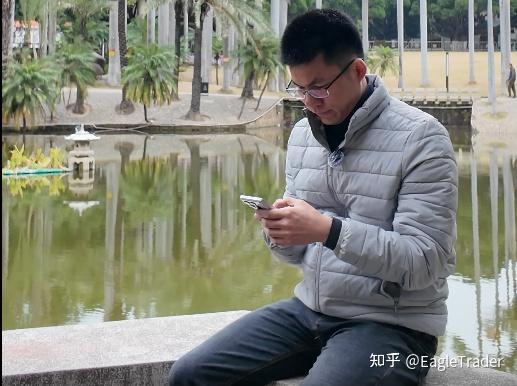
Rather than passively waiting for the cycle to pick up, he is more inclined to actively look for new possibilities. In fact, financial transactions had already entered his field of vision before he officially changed careers. Wang Wenbin had participated in stock investments in his early years and was no stranger to market fluctuations. This also made him not start from scratch when considering transformation.
In order to make his choice more secure, he did not change jobs rashly, but first supplemented his knowledge and abilities. In more than a year of systematic study, he gradually expanded from stocks to foreign exchange and futures, reorganized financial logic through training, and laid the foundation for this transformation through the accumulation of parallel work and study.
Why should I participate in ET after full-time trading?
After completing the systematic study, Wang Wenbin successfully entered a formal financial company and became a full-time trader. In a stable working environment, he was able to devote his main energy to trading itself.
<img alt="" src="https://www.hudianbaoseo.cn/uploads/allimg/20260213/1770945127381183.jpg" width="654" height = 449 In fact, he will have more ideas, which is a way of self-improvement.
Currently, he devotes 60 to 70% of his time to trading, mainly operating U.S. futures. Trading hours are relatively flexible, both during the day and at night, but he prefers trading during the day because he believes that the market rhythm and execution experience are relatively better. After work, he still maintains the habit of playing basketball and playing games to relieve the pressure of trading.

Even though he became a full-time trader, he did not stop studying as much as he did when he was a beginner, but his continued focus on financial knowledge was still an important support for him to maintain his trading status. In the process of working stably and taking self-employment exams in parallel, he gradually found a way. A growth path that suits you.
The attitude of family members and the source of “sense of stability”
Switching from real estate to financial transactions is not an easy decision for any family. Wang Wenbin also admitted that when he really decided to change his career, his family’s attitude was not completely supportive from the beginning.In the past, state-owned enterprises meant stability, and financial transactions were inherently risky. “It was actually very confusing at the beginning.”
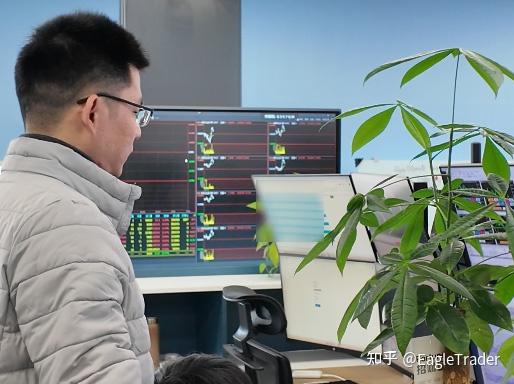
This concern is not difficult to understand. But as he entered a formal financial company and engaged in full-time trading work, his family’s mentality gradually changed. At least, with a clear career framework and a stable job, this path no longer seems so “uncontrollable.” As he said, with a stable job as a support, his family will gradually feel at ease.
As for why he chose to take the EagleTrader proprietary trading exam in the first place, his considerations were equally rational. A high profit margin ratio and no need to use own funds are the most direct attractions. In his opinion, this model can not only amplify the testing value of trading ability, but also reduce stress at the psychological level, which is a positive help to the trading mentality.
Opinions on the Proprietary Trading Exam
Although he has passed the EagleTrader Proprietary Trading Exam, Wang Wenbin will not easily encourage everyone to participate. On the contrary, he has always maintained a restrained attitude towards “novice entry”.
He believes that the significance of self-operated assessment is to test whether trading habits and risk control can withstand market scrutiny, but the premise is that traders must have basic strategic understanding, otherwise even if problems are exposed, it will be difficult to effectively correct them.
Therefore, when someone around you consults EagleTrader
When doing so, he usually first understands the other party’s trading years, strategy maturity and risk perception, and only after a certain basis for judgment will he suggest trying it. In his view, there are no shortcuts to trading, and insufficient knowledge and preparation will only ineffectively amplify time costs.
After the interview, Wang Wenbin gave people the overall impression of being brave but rational. Faced with a huge industry change, he did not make decisions based on impulse. Instead, through continuous learning and repeated practice, he gradually transformed his personal interests into a sustainable career path.
From a state-owned real estate company to a full-time trader, to participating in the EagleTrader proprietary trading exam, he never chose to “leap forward”. On the contrary, he prefers to put uncertainty into rules and structures, so that every choice is within control.
For him, trading has never been a big gamble, but a professional ability that requires long-term verification and repeated polishing. And this point constitutes the most important dividing line between professional traders and ordinary market participants!