
ET Insights | Don’t rush to chase breakthroughs, how Turtle Soup captures the market’s “wrong direction”
- 2026年7月28日
- Posted by: Eagletrader
- Category: News
In the last issue of ET Trading Insights, we shared Liquidity
The Sweep (liquidity sweep) strategy explores why the market triggers a large number of stops at key positions, and how traders can look for potential trading opportunities by observing changes in liquidity.
In the actual trading process, in addition to liquidity sweeps, there is also a common market phenomenon: the price breaks through a key position, attracting a large number of traders to enter the market, but the market does not continue to develop in the direction of the breakthrough, but quickly returns to the original price range, or even shows a reverse trend.
<img alt="" src="https://www.hudianbaoseo.cn/uploads/allimg/20260728/1785204093105642.jpg" width="654" height = 343
When a breakthrough becomes a trap, what exactly happens in the market?
In the trading market, breakthroughs have always been regarded as an important signal for the start of a trend. When the price breaks through the previous high, many traders will think: “The power of the bulls is increasing, and the market may enter a new rising stage.”
And when the price falls below the previous low, it is easy to judge: “The shorts have taken advantage, and the market may continue to decline.” Therefore, breakout trading has become an important way for many traders to capture the trend.
But not every market breakthrough will form a trend. Some breakouts appear to represent directional choices but are actually just brief price moves.
For example:
After the price breaks through the previous high, it attracts traders to chase the increase and enter the market; then the buying is unable to continue to push the price up; the market falls back to the breakthrough area; eventually forming a failed breakthrough.
For traders chasing breakthroughs, this means: the market does not continue after entering the market, and the stop loss is even triggered quickly.
For another type of trader, this “breakthrough failure” process may become an important signal for finding reversal opportunities.
What is the Turtle Soup strategy?
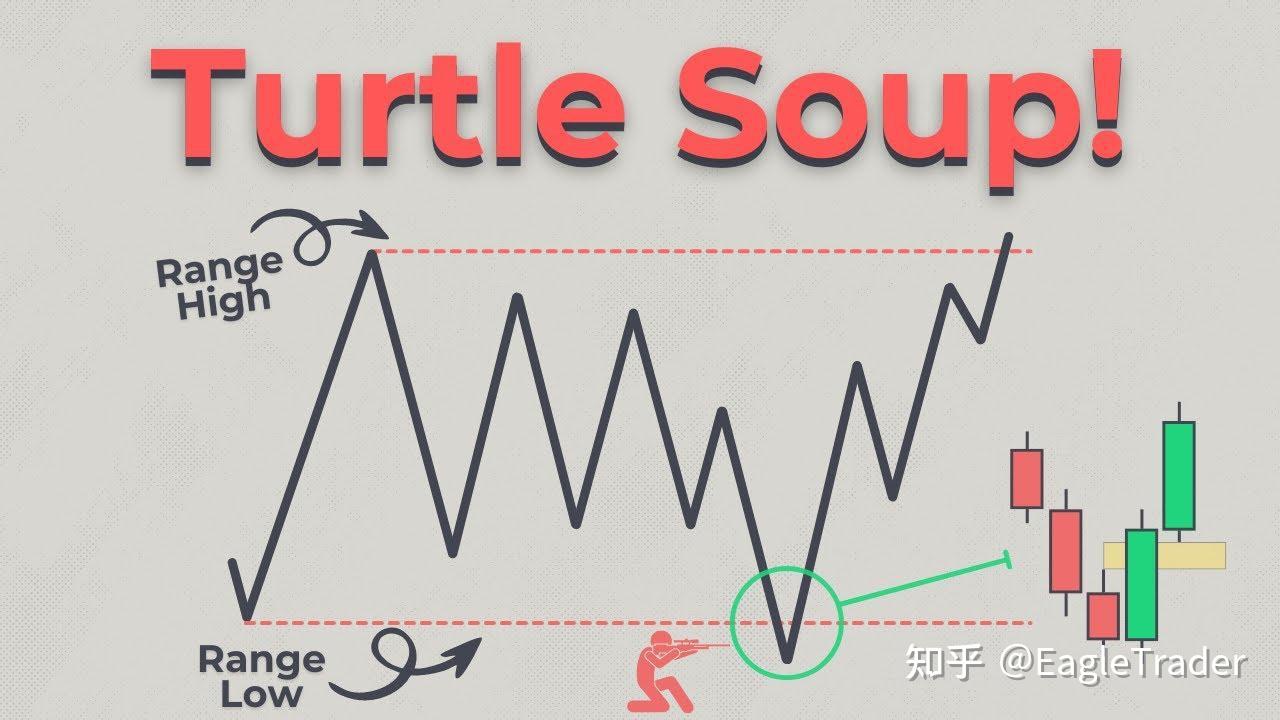
Turtle Soup (turtle soup strategy) is a classic fakeThe breakout and reversal trading strategy was proposed by the famous American trader Linda Bradford Raschke.
Linda Raschke is one of the world’s well-known price action traders. She has long studied market structure, price action and short-term trading methods, and has accumulated rich experience in the trading field.
Turtle
The core concept of the Soup strategy is: when the market breaks through a key position, if it cannot maintain the breakthrough state and the price returns to the original trading range, it may mean that the power in the original direction is insufficient and there is an opportunity for reverse correction in the market.
Its name comes from the classic “Turtle Trading Rules”. The Turtle Trading System emphasizes: Breakthrough → Follow the trend.
Turtle Soup focuses on another situation: breakthrough → failure → reverse trading.
To put it simply: Turtles look for breakthrough opportunities, while Turtle Soup looks for failed breakthroughs.
How does Turtle Soup identify false breakthroughs?
In actual trading, Turtle Soup usually focuses on three key steps.
First, look for important price positions
False breakthroughs usually do not appear randomly, but more often occur at positions that the market pays attention to, such as:
Previous highs; previous lows; important support and resistance areas; integer points. These positions tend to gather a large number of trading orders.
For example: when EUR/USD is close to the 1.1000 integer mark: some traders may wait for a breakthrough to buy; traders with existing short orders may set their stop loss above.
Therefore, when the price breaks through this area, it is easy to trigger a large number of orders.
Second, observe whether the breakthrough is truly effective
A true trend breakthrough usually has:
The price can continue to run after the breakthrough; the market is willing to accept new price areas; and the buying and selling power continues to promote the market. Failed breakthroughs usually manifest themselves as:
The price breaks through quickly; lacks sustained momentum after the breakthrough; and quickly returns to the original trading range. This means that although the market tried to develop in a new direction, it did not form sufficient market consensus.
Third, wait for reversal confirmation
Turtle Soup does not trade immediately when it sees a failed breakout, but waits for price action confirmation. For example:
Short-selling opportunities:
The price breaks through the previous high; cannot continue to rise; falls back below the breakthrough position; look for reverse short-selling opportunities. The opposite is true for long opportunities:
The price falls below the previous low; the seller lacks strength; returns to the key position; looks for rebound opportunities.
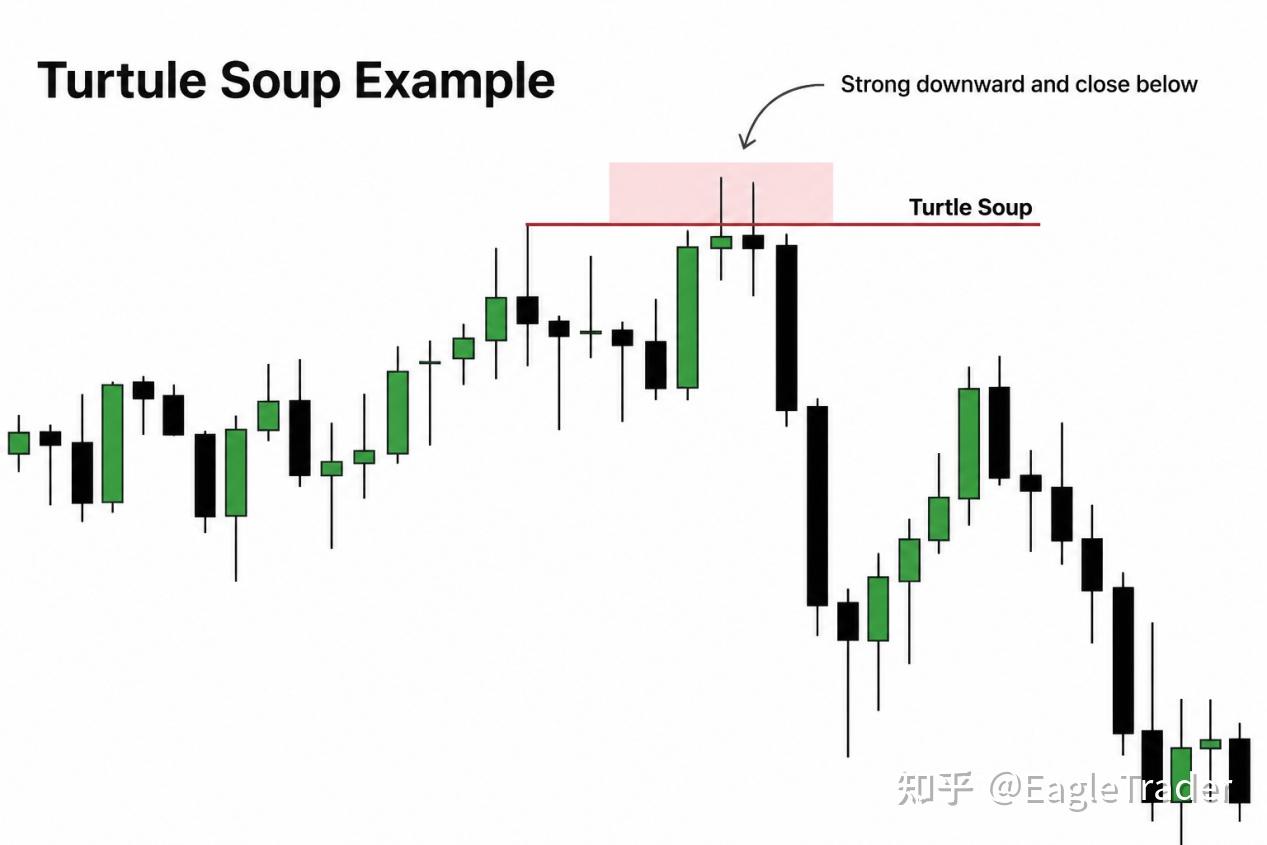
Why is Turtle Soup prone to occur in the foreign exchange market?
For foreign exchange transactions, Turtle Soup
False breakthrough strategies such as Soup have high reference value. First of all, the foreign exchange market has long trading hours and high liquidity, and important price areas often gather a large number of trading orders. For example:
Integer levels in major currency pairs:
EUR/USD 1.1000
GBP/USD 1.3000
These positions are likely to become areas of market concern.
Secondly, the foreign exchange market is often affected by macro data and emergencies.
For example: after important economic data is released, the price may quickly break through a certain position, attracting a large number of traders to follow.
But prices may also return quickly as the market re-evaluates the impact of the information. Therefore, in Forex trading, a breakout does not necessarily indicate a trend is forming.
What traders need to pay attention to is whether the market actually accepts the new price after the breakthrough.
From the first issue of Liquidity Sweep to the current issue of Turtle
Soup, what is reflected behind different trading strategies is traders’ understanding of market structure, capital behavior and risk control.
ET Trading Insights Series will continue to share more classic trading logic to help traders shift from focusing solely on price trends to gradually establishing a more systematic market analysis method.
EagleTrader always pays attention to the growth of traders’ abilities. Through a more systematic assessment system, multi-dimensional trading performance evaluation and continuous trading insight sharing, it accompanies traders to continuously improve their trading knowledge and explore more professional trading growth paths.