
Gold has fallen for 5 days in a row. Why are many traders crazy about this wave?
- 2026年11月25日
- Posted by: Eagletrader
- Category: News
Gold has fallen for 5 days in a row. Why are many traders crazy about this wave?
Last week, the gold market experienced a rare extreme situation, plummeting for five consecutive trading days.
Faced with this unilateral rapid decline, EagleTrader’s backend data shows that many traders have “got ahead” in this wave of market conditions: some people continue to buck the trend and guess the bottom, and some frequently chase short positions with heavy positions, which ultimately leads to an unbalanced mentality and frequently triggers the risk control red line. Unfortunately, this challenge ended.
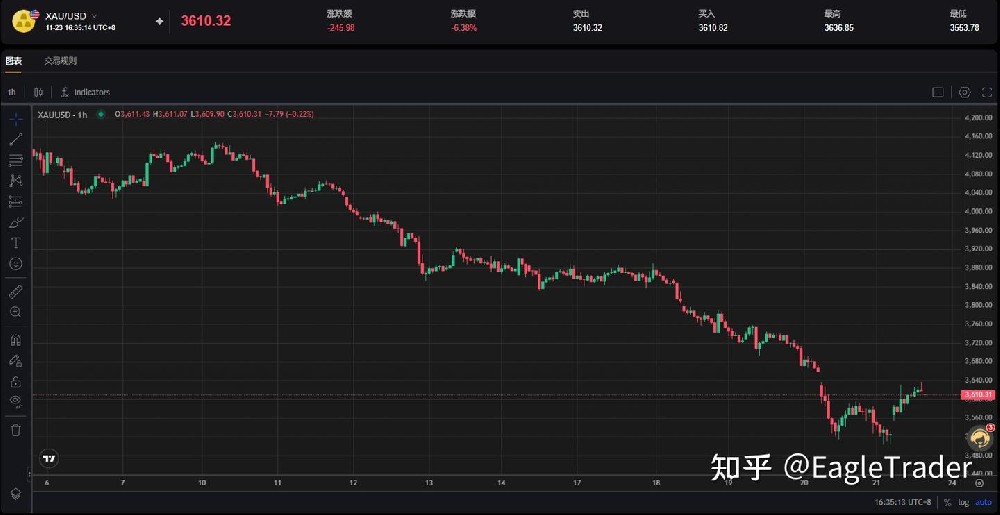
Big market trends are often the breeding ground for big losses.Why are all the principles that we usually understand forgotten when there are big fluctuations? Today, we use this wave of gold plummets to talk about the three blind spots in understanding that traders are most likely to fall into.
Blind Spot 1: Taking “keeping an eye on the market all the time” as a professional and being tempted by the market to trade frequently
In the past few days when gold has plummeted, many traders have watched from the opening to the closing price, fearing that they would miss a rebound or dive in the blink of an eye.
It’s not that the public doesn’t know that trading means paying handling fees, but when faced with the temptation jumping on the market, they always feel that “it would be a pity not to reach out and grab a handful.”
As a result, the cycle that should have been short positions and waiting turned into a frequent pursuit of gains and losses.
True professionalism is never about keeping an eye on the market all the time.
The speculative market is ever-changing, and violent fluctuations in the market are often more traps than opportunities.
When you put yourself in a state of uncertainty and restlessness, no matter what you choose, you will easily lead to losses.
Real masters know how to keep a distance from the market, because they know that big market trends never end overnight.
What you have to learn is to wait for opportunities and trade instead of being tempted to trade.
Don’t let yourself be immersed in the illusion of always watching the market. Remember, the market is sometimes like a slot machine.
Blind Spot 2: Over-reliance on chart patterns and ignoring the true “price” position
Gold continued to plummet. Many traders looked at the chart and felt that “it fell out of the long lower shadow line” or “an oversold bottom pattern appeared”, so they immediately bought the bottom, only to be directly penetrated by the subsequent large negative line to stop the loss.
Today’s trading software makes drawing extremely simple, and K-lines, moving averages, and various technical forms have become widespread.
Everyone likes to look at graphics for trading because they are the most intuitive.
But just because everyone is watching, the technical form can easily become a tool for the main market forces to deceive retail investors – when they want to induce you to buy, the trend will be very strong; when they want you to panic sell, the trend will be overwhelming and you can’t breathe.
What you should really focus on is the objective “price” rather than the subjective “graphic”.
When is it low? When is it high? Don’t look for answers in patterns.
This requires you to abandon blind reliance on graphics, deeply understand the support and resistance at key positions, and focus on the structural range of the price itself.
The ancients have long summarized: “What is expensive is like dung, and what is cheap is like pearls and jade.” When the price falls to a real value depression, there is no need for a perfect K-line pattern, and it is also the time to enter the market.
Blind spot three: In the leverage market, there is a lack of “timid” awe
People who enter the speculative market tend to have one thing in common – the courage to take risks.
Especially in proprietary trading, many people feel that “if you want to pass the assessment, you must dare to take a big risk.”
But the opposite is true: the riskier the market (especially highly leveraged derivatives like gold), the higher the value of timidity.
In this continuous falling market, many people dare to buck the trend and catch the flying knife, but there are very few people who know how to admit “I don’t understand” in a unilateral decline, and therefore choose to wait and see with a short position or strictly light a position.
In this market, personalities resonate. The bold ones often react in the same way (buy the bottom together and die together), while the cautious ones quietly become a minority and make profits.
In this market, timidity and caution are an extremely rare and precious quality.
As long as you are still in this market, you should strive to become more timid and awe-inspiring.
Admitting that you lack courage and dare not place random orders is precisely the most courageous expression in this market.
In proprietary trading, the maximum drawdown and intraday drawdown limits we set are actually to help you control those hands that “can’t help but click the mouse randomly” in extreme market conditions (such as last week’s gold).
Trading is a marathon, not a slot machine where you have to win or lose every day.
The more intense the market, the more you need to remind yourself: maintain moderation, pay attention to the price, and always be in awe.