
How to verify strategy stability? Monte Carlo simulation that traders must understand
- 2026年8月7日
- Posted by: Eagletrader
- Category: News
Many traders will verify their trading strategies through historical backtesting before participating in the EagleTrader challenge.
When a strategy shows good return performance in historical data, traders tend to think that they are ready.
However, during the actual trading process, many strategies did not continue to run according to the backtest results, and even in the early stages of the assessment, risk control rules were triggered due to risk control issues.
The reason is that historical backtesting can only show the performance of the strategy in a specific market period, and the future trend of the market will not completely copy the past.
The true stability of a strategy does not depend on how much profit it has gained in a certain historical market, but on whether it can still remain effective in the face of different market paths, different transaction sequences, and extreme volatility environments.
Therefore, in addition to paying attention to historical return performance, professional traders will also analyze the risks that strategies may face through stress testing.
Among them, Monte Carlo Simulation is an analysis method commonly used to evaluate the stability of trading strategies.

What is Monte Carlo simulation in trading?
Monte Carlo simulation is a stress testing method based on probability statistics. Its name comes from the Monaco Monte Carlo Casino because the core of the method revolves around random events and probability distributions.
Today, Monte Carlo simulation is widely used in the field of financial analysis to evaluate the possible results of investment portfolios and trading strategies under different scenarios.
To put it simply:
Monte Carlo simulation does not predict future market conditions, but analyzes the different results that the strategy may experience through a large number of random simulations based on existing transaction data.
For example:
Suppose a trader completed 100 trades in the past year, including profitable trades and losing trades.
Traditional historical backtesting can only see a capital curve formed by these 100 transactions in the order they actually occurred.
But the market will not repeat the past in the same order in the future. If continuous losses occur first in the future, or profitable transactions occur intensively, the account performance may change significantly.
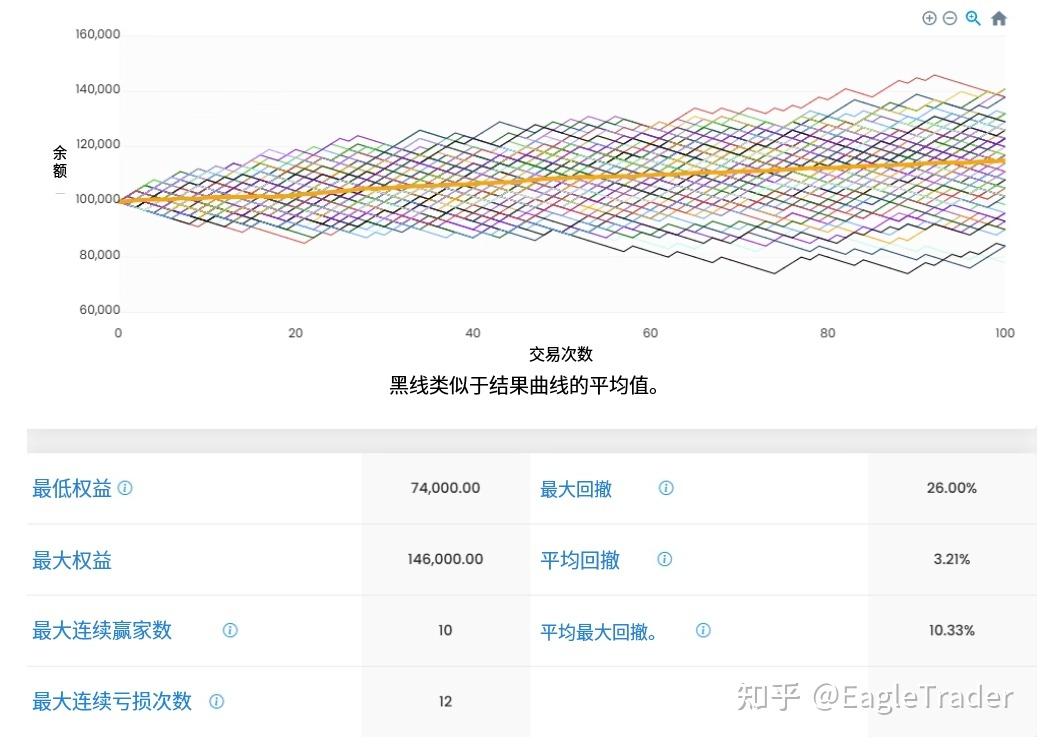
Monte Carlo simulation will use these historical transaction results as a basis to generate a large number of different simulated capital curves by randomly rearranging the transaction order and adjusting the income distribution.
Through these results, traders can observe:
The strategies perform better in different trading situations.Performance under the sequence;
The maximum possible retracement range; the account’s ability to withstand continuous losses. This can help traders understand the strategy more comprehensively, rather than just relying on a single historical backtest result.
Why do traders need Monte Carlo simulation?
For trading strategies, profitability is only part of it. What is more important is whether the strategy has the stability to continue running. Monte Carlo simulation can mainly help traders evaluate from three aspects.
1. Verify whether the strategy can withstand continuous losses
Even if a strategy has positive profit expectations in the long term, short-term losses may still occur.
For example, a strategy with a historical winning rate of 60% does not mean that every 10 transactions must appear in the order of 6 profits and 4 losses.
In the actual trading process, five consecutive losses or more may be considered normal statistical fluctuations.
If traders do not assess the situation in advance, overly large positions can cause the account to quickly hit the risk limit.
Through Monte Carlo simulation, traders can observe the performance of the strategy under different loss sequences and adjust the risk ratio based on the results.
2. Determine whether the income comes from strategic advantages or accidental market conditions
Excellent performance in historical backtests does not mean that the strategy must have long-term stability.
Some strategies may just be suitable for the market environment at a certain stage, and therefore obtain higher returns in specific market conditions.
But when the market rhythm changes, the performance of the strategy may decline significantly.
Monte Carlo simulation can help traders judge whether the strategy can still remain relatively stable if the transaction sequence changes by testing a large number of different trading paths.
If most of the simulation results are consistent, it means that the strategy has stronger anti-random ability; if only a few simulation situations perform well, the reliability of the strategy needs to be further evaluated.
3. Establish reasonable retracement expectations
Many traders focus on how much profit the strategy can gain, but lack an accurate understanding of how much retracement the strategy may experience.
Monte Carlo simulation can help traders understand the possible range of capital fluctuations in strategies under different market environments.
This helps traders plan ahead:
Appropriate position size; acceptable risk level; more reasonable trading expectations. How to apply Monte Carlo simulation to EagleTrader challenges?
For traders participating in the EagleTrader challenge, the importance of strategy stability is even more prominent.
The assessment not only requires traders to create profits, but also tests whether traders can execute strategies within the scope of risk rules.
Therefore, before officially entering the challenge, evaluating the strategy’s ability to withstand pressure through Monte Carlo simulation can help traders formulate trading plans more rationally.
1. Optimize position management
Many traders fail to pass the challenge not because the strategy is unprofitable, but because the position setting cannot adapt to normal market fluctuations. For example:
If the risk ratio of a single transaction is too high, even if the strategy has long-term advantages, the account may reach the risk limit due to continuous losses.
By simulating different risk parameters, traders can find a position plan that is more in line with the characteristics of their own strategy.
2. Assess risk boundaries in advance
Market fluctuations are not only reflected in realized losses, but also in floating changes during the position holding process.
Monte Carlo simulation can help traders test whether the current strategy and position can easily approach the risk limit when the market experiences continuous adverse trends.
Understanding the strategy boundaries in advance can help reduce passive adjustments during the actual trading process.
Historical backtesting can help traders discover strategic advantages, but truly mature trading strategies still need to be tested in different market scenarios.
The value of Monte Carlo simulation is not to predict the future, but to help traders understand the risks that strategies may face in advance and make more reasonable trading plans.
For traders who want to challenge and further improve their trading capabilities through EagleTrader, stable profits not only come from a set of effective trading logic, but also from the continuous optimization of strategic risks, position management and execution discipline.