
If you always lose profits after making profits, you need to be wary of this psychological trap.
- 2026年9月21日
- Posted by: Eagletrader
- Category: News
When your account has a floating profit of $8,000, and you stare at the screen, you may have a thought in your mind: You have already made so much, it shouldn’t be okay to relax a little.

As a result, the trade that was originally used to use 1-lot position became 3-lot.
The market then retraced.
Faced with a loss, you did not stop the loss in time as usual, because there was still profit earned previously in the account.
By the time you realize that the risk has exceeded the plan, the original floating profit may have been retreated significantly, and it may even begin to approach the risk control line of the account.
If you’ve ever experienced a moment like this, the problem may not actually be your technique, or even your discipline—it’s that your brain is doing something you’re not aware of.
The ledger in your brain that you can’t see

Nobel Prize winner in economics Richard Thaler proposed a concept in the 1980s that later profoundly influenced behavioral finance: mental accounting.
It describes a common phenomenon: people psychologically divide money into different “accounts” based on its source, use and method of acquisition, and adopt different attitudes towards them.
The same 10,000 yuan, the 10,000 yuan received as a year-end bonus may have completely different psychological feelings when consumed than the 10,000 yuan saved for a long time.
From the perspective of economic value, they are all 10,000 yuan; after entering the human decision-making system, they may be given different meanings.
A similar situation occurs in trading accounts.
When an account starts to make profits, it is easy for the brain to mentally separate the profit part from the initial capital.
The money already earned will gradually be regarded as a space that can bear more risks.

In their 1990 study, Thaler and Johnson summarized a similar phenomenon as the “House Money Effect.”
Effect): After people have just gained profits, their acceptance of subsequent risks may increase, because the previous profits psychologically reduce the pain of another loss.
When put into trading, this change can appear very concrete.
The originally fixed positions began to increase, the stop loss range became wider, the trading frequency increased, and some transactions that would not be executed under normal circumstances began to enter the account.
The strategy has not changed, and the market may not have fundamentally changed. What has changed is the traders’ psychological definition of account funds.
After profits are made, risk standards may also quietly change
A very typical manifestation of psychological accounts in trading is that traders adopt different risk standards for “principal” and “profit”.
When an account first starts, there are usually clear plans for positions, stop losses, and single risks; but when the account has accumulated a portion of profits, the original boundaries are easily relaxed.
Positions that you would not accept before may start to feel like “you can give it a try”; positions where you should stop loss may also wait a little longer because there is still profit.
The problem lies here.
Judging from the trading results, the principal and profit in the account will eventually be reflected on the same equity curve.
Once profit enters the account, it also needs to be incorporated into risk management rather than turning into additional risk budget.
The dynamic retracement rules of EagleTrader Max can see this very intuitively.
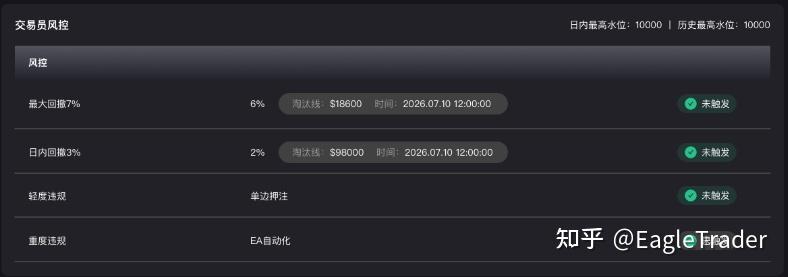
Max has set a maximum retracement of 7% and a maximum intraday retracement of 3%. Both risk control lines will follow changes in the account’s highest water level.
Among them, the maximum drawdown risk control line is calculated based on “historical highest water level – initial account size × 7%”.
For example, for a $100,000 account, when the historical highest net worth reaches $109,000, the maximum drawdown risk control line will simultaneously move up to $102,000.
This means that after the account creates new profits, the risk boundary will also change accordingly.
Not all the $9,000 earned previously will become room for taking risks again.
The dynamic retracement of 3% within the day has a similar logic.
After the account net value reaches a new high that day, the intraday risk control line will also be adjusted accordingly.
Therefore, just because a profit has been made in the morning, it does not mean that the position can be enlarged or the trading frequency can be increased accordingly in the afternoon.
The two rules correspond to different time scales: 7% focuses on the entire account cycle, and 3% focuses on a single trading day, but they all point to the same question—whether traders can maintain their original risk standards after the account makes profits.
This is also where mental accounting can most easily affect trading decisions.
Many times, the strategy has not changed, and the market has not required traders to increase risks. It is just that people’s acceptance of the same loss has changed because the account has made money.
Rules will not eliminate this psychological tendency, but they can draw a clear boundary for risks.
For traders who have formed a mature trading system, what really needs to be maintained is that positions, stop losses and risk budgets are still based on the same set of logic, regardless of whether the account is in the profit or retracement stage.
Back to the $8,000 floating profit at the beginning of the article.
If this part of the profit does not appear, you may not suddenly increase the number of lots from 1 to 3, and you will not be willing to let the transaction that was originally supposed to stop loss continue to run.
So what changes your decision-making is not necessarily the market, but also the way you manage your funds.