
Multiple sets of quantitative models capture the golden trend. Why does [Jin Tailang] make it to the list of star signal sources?
- 2026年8月6日
- Posted by: Eagletrader
- Category: News
Nowadays, there are more and more self-operated trading platforms at home and abroad, and many novice traders also want to try this trading model. However, how to choose a platform, how to read the rules, and how to divide the money are all things that must be sorted out before entering the game.
In this article, we will use the mechanism of local proprietary trading EagleTrader (ET for short) as a reference to help you sort out a clear participation path and save the cost of blind guessing.

Platform screening: transparency is the primary consideration
When choosing a self-operated platform, transparency of rules should be top priority.
A platform with standardized operations will disclose all assessment conditions, profit sharing mechanisms, risk control objectives, and prohibited trading behaviors, etc., rather than hiding them behind “final interpretation rights” or vague statements.
In addition, the trading environment and retracement algorithm should also be confirmed by traders in advance.
Take ET as an example. Its official website explains the complete rules of each challenge, which are displayed in the “FAQ”, including calculation examples of profit targets and maximum drawdowns.
This approach of laying out the rules directly can be used as a basic criterion to judge whether the platform is worthy of further understanding.
<img alt="" src="https://www.hudianbaoseo.cn/uploads/allimg/20260806/1785979844455081.jpg" width="654" height = 374
If the strategy is short-term or scalping trading, the single stop loss is tightened, the position holding time is short, and smaller accounts (such as the $10,000 or $25,000 challenge provided by ET) are often more conducive to strict risk control.
If the strategy favors swing or trend trading, the stop loss range is wider, and more time is needed for profits to develop, you can consider an account with a level of 50,000, 100,000, or even 200,000 US dollars. Its larger nominal capital can provide a more leisurely retracement buffer.
ET has just set up multiple levels of account sizes, and different sizes correspond to differentiated profit targets and retracement parameters, allowing traders to “select accounts based on policy.”
This layered design idea is closer to actual transaction needs than unified specifications.

Assessment objectives: Conditions that need to be interpreted one by one
The rules of the self-employment assessment are essentially a set of open-book questions. No matter which platform you choose, you should at least clarify the following four core conditions to avoid assessment failures caused by misunderstandings.
The following is a brief reminder of each condition, taking the setting of ET as an example.
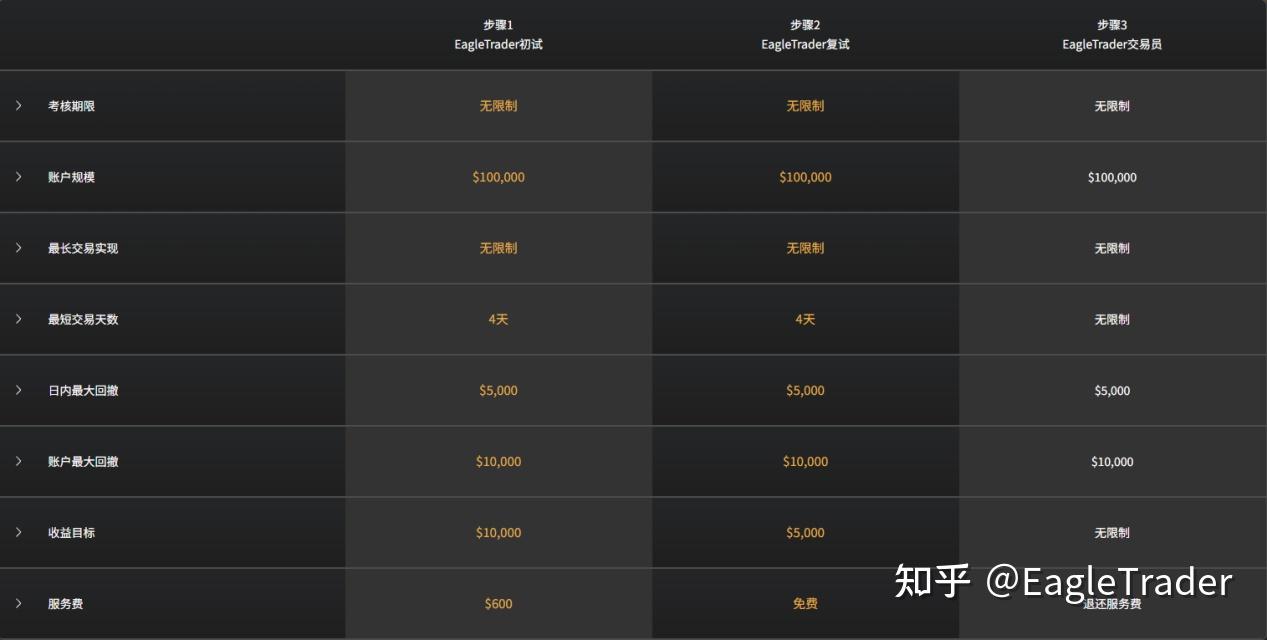
1. Maximum retracement limit
Most platforms have retracement red lines.
ET assessment adopts a two-layer risk control mechanism, which usually includes two constraints: total drawdown and daily drawdown. The specific values vary depending on the account specifications.
This type of design objectively forces traders to establish daily risk control awareness in daily transactions, rather than just focusing on final profits and losses.
2. Profit target
The assessment is often conducted in stages.
ET’s model sets a relatively high profit target in the first stage, mainly to test profitability; in the second stage, it lowers the target and focuses on verifying the stability of compound interest.
The stage splits and percentages of different platforms are different, so you need to check them one by one before starting.
3. Number of trading days and transactions
This item is easily overlooked. Some platforms have requirements for the minimum number of transactions or consecutive trading days. If the standards are not met, the transaction will be deemed failed.
The regulations of the ET challenge are relatively loose, requiring only a minimum number of active trading days and no hard transaction threshold, providing the necessary rhythm flexibility for non-full-time traders.
4. Other unique conditions
Some platforms will add “consistency rules”, such as disqualification if a single profit ratio is too high, or strictly prohibit trading during news periods, holding positions overnight, etc.
ET retains a high degree of strategic freedom within a reasonable risk control framework, does not easily determine violations based on the profit structure of a single transaction, and also allows reasonable positions to be held over the weekend during the assessment period.
Of course, any operation that exploits loopholes in the rules will still be restricted, but its tolerance for strategy diversity is of positive significance to traders with a mature system.
It is recommended that you read through the complete rules document of the target platform before participating, and form a clear understanding of the above conditions before taking action.
Profit sharing: focus on proportion and redemption rhythm
After passing the assessment, profit sharing is the most direct reward for traders.
Two aspects need to be focused on: the sharing ratio, and the practical conditions for application and issuance.
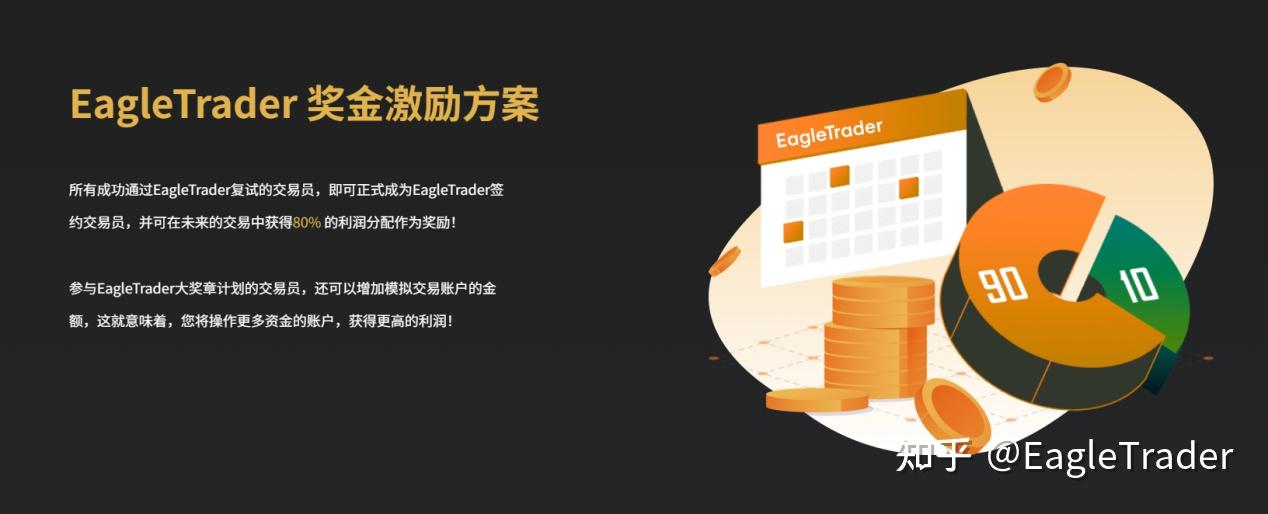
In terms of share ratio, the current applicable ratio for EagleTrader Challenge Edition traders is 80% to 90%, which is a relatively high range in the industry.
You should pay attention to whether the ratio is fixed or floating, and whether it is linked to trading performance.
The step of applying for sharing is also critical:
Generally, the account is required to have positive profits and no excessively risky positions.
In terms of application, as long as the conditions are met, ET profit sharing can be applied for review within 4 profit days, and it is not mandatory to accumulate it for several months before it can be withdrawn.
Although the share ratio is important, the timeliness and stability of redemption are of more practical value than the number itself.
Space for advancement: long-term path after the assessment
One-time assessment cooperation will only be of limited help to traders’ long-term development. A more valuable platform usually designs a subsequent growth system.
EagleTrader also has advanced projects such as “Eagle Plan” and “Medal Plan” after passing the basic challenge, providing traders with consistent and stable performance with access to manage larger funds and additional rewards.
This means that participants can view proprietary trading as a sustainable career path rather than a one-time breakthrough.
The essence of proprietary trading is to exchange proven trading capabilities for greater trading capital.
In this process, choosing a platform with clear rules, inclusive strategies, reasonable distribution, and room for advancement is the prerequisite to ensure that your efforts are not diluted by the rules.