
New trend in proprietary trading: What is more attractive than big funds is systematic growth
- 2026年7月9日
- Posted by: Eagletrader
- Category: News
In the past two years, proprietary trading (Prop
Trading) continues to heat up in global markets. More and more professional proprietary trading platforms have appeared one after another, and many international securities firms have also begun to launch their own proprietary trading plans, making this model attract the attention of more and more traders.
Many people believe that prop trading is popular because it provides traders with larger trading capital.
However, as the industry continues to develop, more and more traders are beginning to find that what really attracts them about proprietary trading is not just financial support, but the assessment model that helps traders continue to grow.
For those who already have certain trading experience, funds are important, but what really limits trading performance is not the account size, but the inability to break through in trading ability.
Trading bottlenecks are often not technical problems
I believe many traders have had such an experience. I have learned various technical indicators and established my own trading strategies; I insist on reviewing the market every day and constantly studying market trends, but it is still difficult to maintain stable profits.
When faced with a loss, whether you can insist on executing the stop loss; after continuous profits, whether you will enlarge your position due to overconfidence; when the market fluctuates, whether you can still execute the transaction according to the original plan instead of temporarily changing the strategy…
These problems can rarely be solved by a book or a set of trading strategies.
They are more like a trading habit that needs to be gradually established through continuous practice, review and correction.
Therefore, more and more professional trading teams are beginning to pay attention to the trading process, not just the trading results.
Helping traders see their own problems
This is also an important reason why proprietary trading assessment is increasingly recognized. When many people come into contact with proprietary trading for the first time, they see rules such as profit targets, maximum drawdowns, and trading cycles. But the significance of these rules is not just to determine whether to pass the assessment.
For example, retracement limits can help traders establish risk control awareness; trading cycles can avoid relying on a few transactions to achieve goals; fund management requirements can help traders plan more rationally.Position and account risks.
The joint effect of these rules is to allow traders to continuously discover their own trading habits and gradually establish a more stable trading system during the process of completing the assessment. This growth process often has more long-term value than simply focusing on how much money you make.
Growth is becoming a new direction for proprietary trading
As the industry continues to mature, the development direction of proprietary trading is also changing. More and more platforms are beginning to focus on the long-term growth of traders, not just the final assessment results.
The growth-oriented proprietary trading assessment launched by EagleTrader is based on this concept. In addition to financial support and profit sharing, ET also hopes to guide traders to gradually improve their trading capabilities through a phased growth mechanism, making growth an important part of the entire assessment process.
For example, EagleTrader
Pro adopts a 7-stage growth system, with each stage corresponding to different ability requirements, allowing traders to gradually improve their trading system in the process of continuous advancement, rather than just pursuing the completion of the assessment in one go.
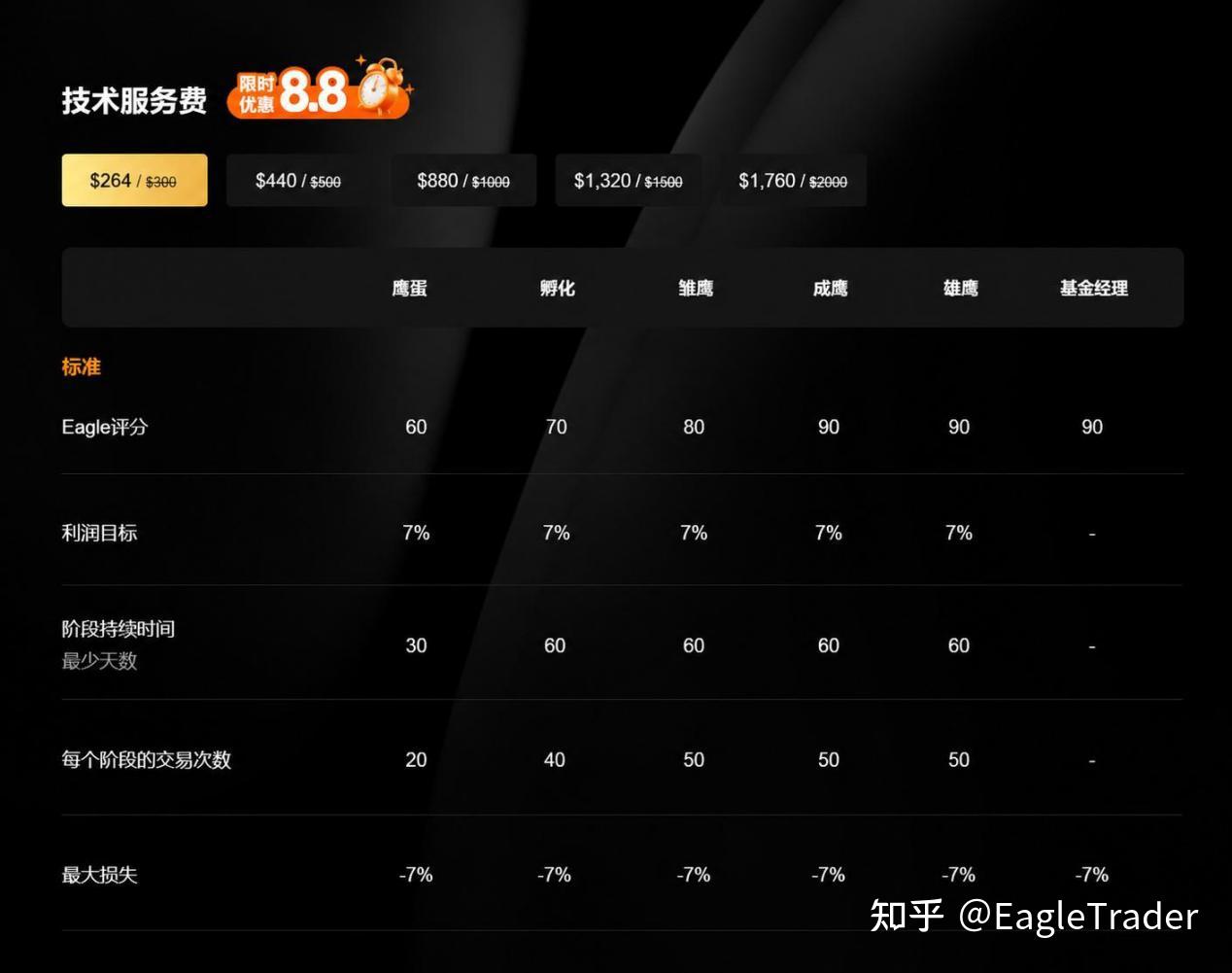
At the same time, the newly launched Eagle scoring mechanism will also comprehensively evaluate trading performance from multiple dimensions such as professional skills, risk management, trading consistency, and trading experience, helping traders to understand their trading abilities more comprehensively.
The purpose of these designs is not to increase the difficulty of the assessment, but to hope that traders can clearly know where their strengths are and what areas are worth continuing to improve at every stage of growth.
When trading capabilities can be continuously verified and continuously optimized, growth will no longer stop at the accumulation of experience, but will have a clearer direction.
Trading growth has no end
The market changes every day. No strategy can be suitable for all market conditions, and no trader can always be 100% correct.
For traders, what is more important than constantly looking for “better strategies” is to constantly improve their trading system. Because stable risk control, mature fund management, strict trading discipline, and the ability to continuously review and optimize will gradually become an important foundation for long-term stable trading as trading experience continues to accumulate.
This is also the reason why more and more traders are re-recognizing proprietary trading and attracting everyone to participate. If you also want to re-examine your trading system, you might as well experience a completely different growth-oriented proprietary trading assessment for yourselfBar.