
Profit and loss ratio of a single transaction is 3 times! After more than ten years of trading suffering, he relied on self-operated assessment to get out of the liquidation dilemma
- 2026年7月27日
- Posted by: Eagletrader
- Category: News
“There is only the south wall of trading, and I have hit it countless times. I will not look back, I will knock the wall down and keep going.”

The person who said this was EagleTrader trader Pan Libin.
In March this year, he just passed the EagleTrader self-operated assessment, and in April he won US$5,000 in profit sharing. In his more than ten years of trading career, from the ecstasy of doubling his small capital to the darkest moments of repeated liquidation, he never chose to give up trading.
In this EagleTrader trader interview, let us focus on Pan Libin, a trader who has gone through many hardships in the market.

More than ten years of ups and downs
After more than ten years in the industry, trader Pan Libin has experienced too many ups and downs.
300 US dollars has increased to 50,000 US dollars, and 500 US dollars has reached more than 20,000 US dollars. This kind of explosion of dozens of times has occurred several times, but more often, it is the repeated liquidation of small accounts.
The most torturous thing is not that you invest one or two hundred dollars and it explodes immediately.
The really uncomfortable thing is that the small amount of money slowly accumulated. After it doubled ten or twenty times to several thousand dollars, I began to have expectations in my heart, thinking that I would be able to do it this time. However, the result still ended in a liquidation, which was a particularly heavy blow.
<img alt="" src="https://www.hudianbaoseo.cn/uploads/allimg/20260727/1785117242179717.jpg" width="654" height = 362 I will go back to the liquidation step.
At this time, you have two selves fighting: the rational one and the inner demon.
Sometimes you really feel that the inner demon is too powerful and you can’t defeat it.On the contrary, he also asked himself whether it was worth it. After more than ten years of trading, his answer was: “Once you get in, you find you can’t go back. That kind of unwillingness is because the sunk costs are too high.
I think the only way out for me is trading.”
The real turning point came after he took the EagleTrader self-operated assessment. The strict risk control rules of proprietary trading helped him control his desire to “get back”: “If I had followed the previous practice of my account, I would have been liquidated repeatedly.
Now that we have risk control, it is relatively less easy to be liquidated.”
Channel lines are the main focus, and trend lines determine the direction
Only when you control your mentality can strategies really come in handy.
When asked about his trading method, trader Pan Libin was also happy to share: “I now mainly use channel lines and trend lines to judge the trend.
When the lows continue to rise and the highs continue to rise, it is an increase; conversely, when the highs continue to move down and the lows continue to move down, it means a decline.
Trading with the trend in the trend.”
And in position management In terms of target setting, he relied on Fibonacci to solidify: “The target is set at 1.382 or 1.618. Generally speaking, 1.382 is a little more, because sometimes 1.618 turns back before the market reaches the market.”
As for entry and exit, his logic is also very clear: “Break the rising trend line, then break the second high, and confirm the two-way high probability to go short.
Don’t chase after going short, wait for it. If it rebounds to the 61.8% position, 50% position, or the position where the support pressure switches, and there is a signal, the target will be set at 1.382 or 1.618.”
Asked how to view the winning rate and profit-loss ratio, he said that both are equally important: “A winning rate that is too low will affect confidence, and it will be difficult to operate an account with an inappropriate profit-loss ratio.
The best profit-loss ratio can be above 2:1. If it reaches 5:1, one stop loss will be covered several times, and the pressure will not be too great.
Under this premise, slowly improve the winning rate, try to achieve more than 50%, and achieve a profit-loss ratio of 2:1, and you will have a good performance in the long run. ”
Practical review sharing
In order to show this strategy more intuitively, trader Pan Libin reviewed several of his transactions during the assessment period.
His habit is: 15 minutes to see the general trend, 5 minutes to do the trading cycle, and then cut to 1 minute to find the entry point. This has only one purpose – to minimize the stop loss.
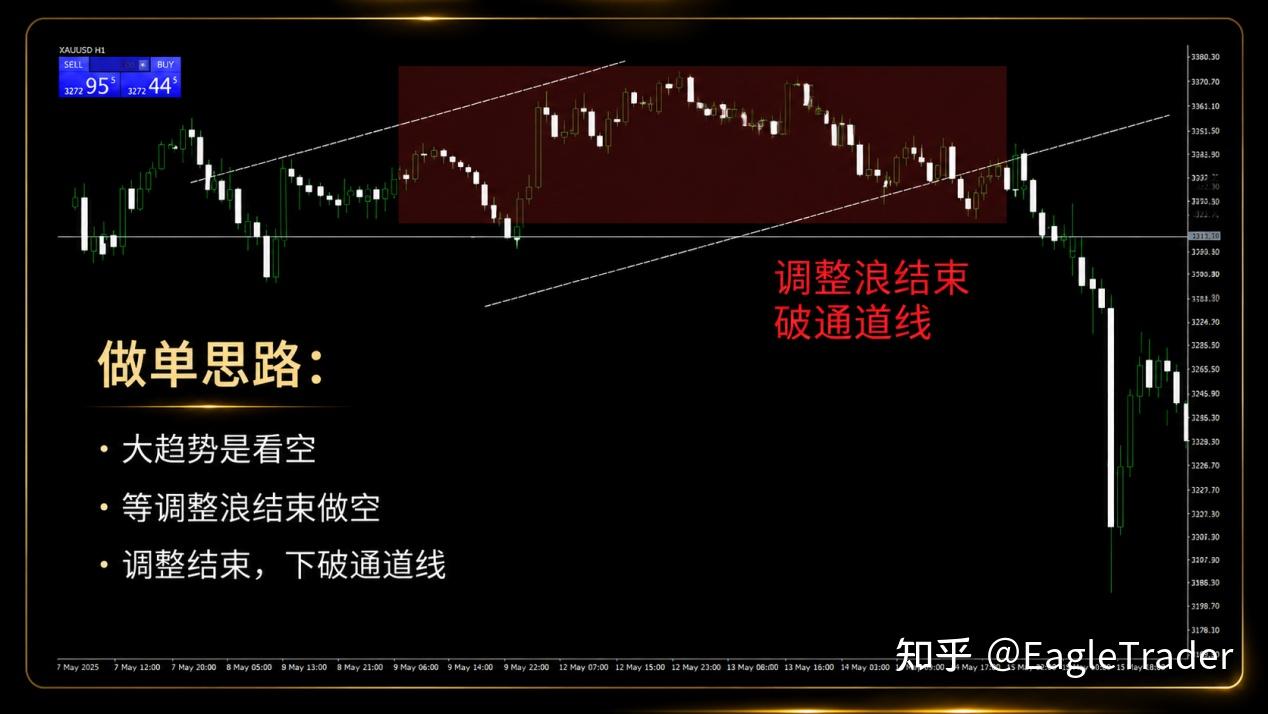
Scenario 1: Channel break and abc adjustment wave
Under the premise that the 15-minute general trend is bearish, trader Pan Libin first drew a descending channel line on the 5-minute chart.
When the market reached the obvious support and pressure transition level in the early stage, he decisively cut into the 1-minute cycle to look for opportunities to break the position.
Disk phenomenon: On the 1-minute chart, the market fell below the ascending channel line, and then came out of an abc adjustment wave..
When the adjustment ends and the position is broken again, short orders enter the market decisively.
Trading results: Due to the accurate entry on the one-minute chart, the stop loss was strictly controlled at the previous high (about 200 points). The final market movement reached the preset Fibonacci target position of 1.382.
Manually close the position and gain more than 650 points in one stroke, achieving a profit-loss ratio of a little more than 3 times.
<img alt="" src="https://www.hudianbaoseo.cn/uploads/allimg/20260727/1785117242479416.jpg" width="654" height = 368
This is a typical “main down wave-adjustment wave” structure.
1.618 Task Take Profit (Order A): Switch to the 1-minute chart, enter the market to go short when the price falls below the sideways adjustment channel line, and control the stop loss within 100 points.
He set his profit target at a deeper Fibonacci level of 1.618. More importantly, at that time, the profit of this order had reached the target for the day, the task was completed, and the profit was immediately taken away.
Second attack after correcting the trend line (order B): Previously, he had encountered a passive stop loss in small-level short selling.
But he was not affected by his emotions, but remained absolutely calm and re-corrected the trend line.
When the price fell below the correction line again, a second short sale was initiated. The stop loss was set at 150 points from the previous high, with the target anchored at 1.382, and finally gained nearly 700 points.
<img alt="" src="https://www.hudianbaoseo.cn/uploads/allimg/20260727/1785117243958809.jpg" width="654" height = 368
In the city like himThere are many traders on EagleTrader who have come out of repeated setbacks in the market.
What the proprietary trading assessment discovers is never people who never make mistakes, but executors who can continue to output positive expected values within a disciplinary framework.
If you also have a strategy that has been polished for a long time and need a stage that can limit risks and amplify profits, EagleTrader’s self-operated assessment channel is open to you at any time.
Risk warning: The trading strategies and cases described in this article are only traders’ personal experience sharing and do not constitute any investment advice.
Foreign exchange and CFD trading involves high risks and may result in capital losses. Past performance does not represent future performance.
Please make prudent decisions based on your own risk tolerance and make independent judgments.