
The era of relying on losses to gain experience has passed: Self-operated assessment is accelerating trading growth in an all-round way
- 2026年8月4日
- Posted by: Eagletrader
- Category: News
If you ask a person who has been trading for three to five years what the most painful experience in trading is, he will definitely tell you – it is the lessons bought with real money. This is the cruelest part of this industry.
Almost all traders know that actual combat is the only way to improve their abilities. No matter how beautifully the simulation is done, once you enter the real market, issues such as profit and loss pressure, execution discipline, risk control, and emotional fluctuations will really emerge. But the problem is that the traditional trading growth path defaults to one thing: you must use your own funds to bear all the mistakes you make during the growth process.
An intraday impulse may wipe out a month’s profits. A bad habit that goes unnoticed may take months of consecutive losses to be exposed. For the vast majority of traders, the biggest limitation to growth is never the willingness to learn or the ability to comprehend, but simply not being able to afford the cost of long-term trial and error. Before the ability matured, the account collapsed first.

Real growth comes from “low-cost practice + continuous feedback”
So, does the growth of excellent traders really come from continuous losses? Obviously not.
The truly effective growth path should be another one: repeated training in an environment close to the real market, using clear rules to constrain trading behavior, and then locating problems through systematic data feedback. Because the improvement of trading capabilities is essentially a closed loop of “trading → feedback → adjustment → re-trading”.
If there is a lack of high-quality feedback in this cycle, traders will just repeat their mistakes or even reinforce them.
A growth system with advancement and feedback
Based on such trading growth needs, EagleTrader launched the ET Pro proprietary trading exam.

It is not a simple “challenge”, let aloneIt’s a gambling-style money breakthrough. ET Pro
Essentially, it is a trading training system that simulates a real money management environment, allowing traders to systematically verify and polish their abilities in an environment with clear rules and controllable costs.
A very important design of this system is: growth is not a one-time deal, but is staged and progressive.
ET
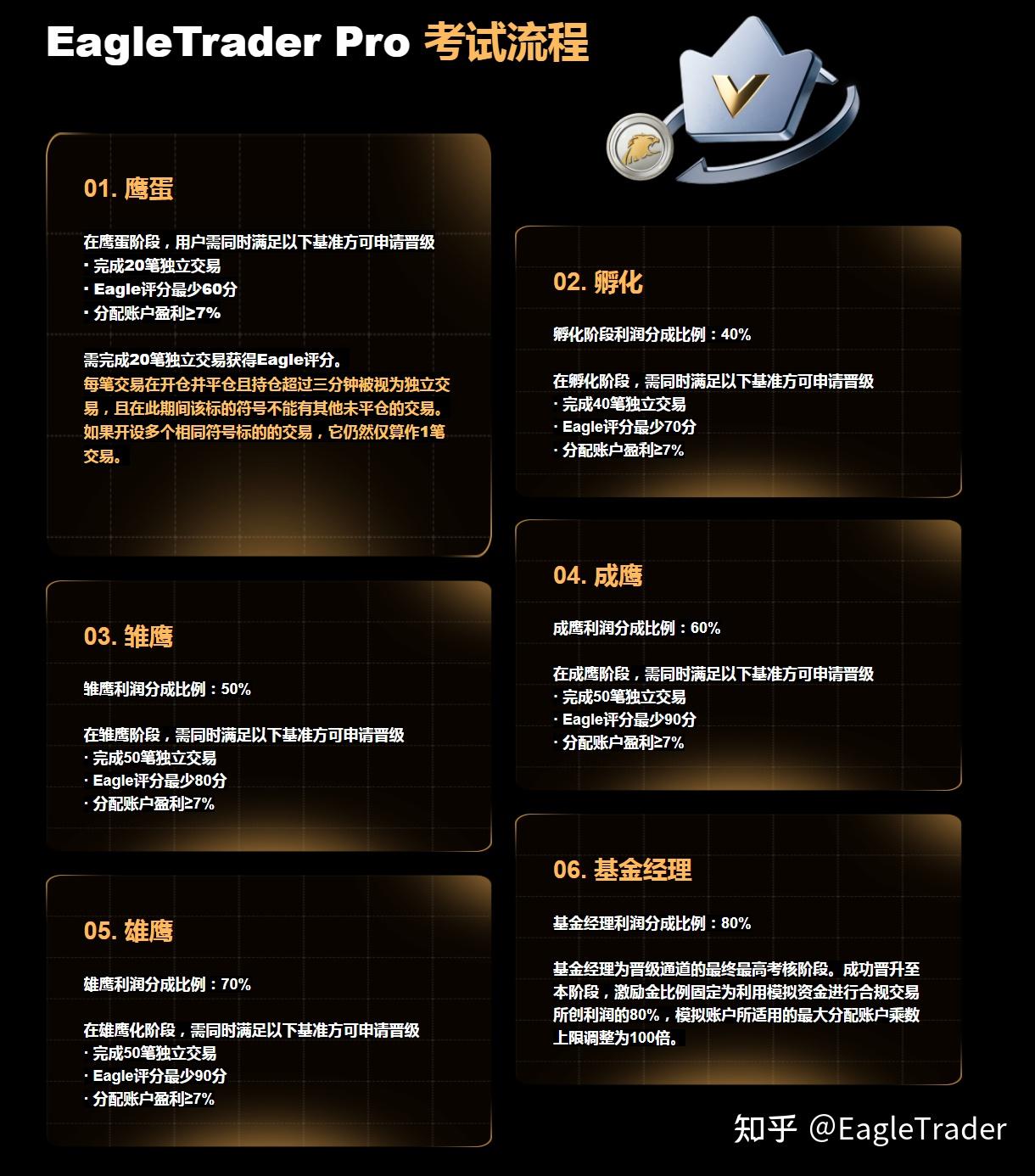
Pro has a seven-level proprietary trading assessment, and traders can challenge it step by step according to their current stage. Each time you successfully advance to a level, you will not only be able to obtain a larger distribution account to follow the operation, but more importantly, you can unlock a higher proportion of the profit share of the distribution account.
What does this mean?
Every time you make progress, you can get real feedback. A higher share ratio directly serves as a trader’s growth incentive, allowing you to receive rewards simultaneously as your capabilities improve.
Turn “use money to buy experience” into “use training to improve ability”
The traditional trading growth model is very straightforward: the bigger the money, the higher the risk, and the cost of every trial and error increases exponentially. A trader who is still in the growth stage and has not yet established stable profitability is forced to bear the greatest financial pressure at the most vulnerable stage – this in itself is very unreasonable.
ET
The Pro model is completely different: it verifies trading capabilities step by step through seven-level rule-based assessments, and then gradually opens up greater trading authority and higher profit sharing. Traders do not need to invest a large amount of personal funds in the early stages of growth to bear all risks, but focus on training risk control capabilities, transaction execution capabilities and stable profitability under a clear rules framework.
Trading growth is no longer using funds to buy experience, but using training to improve abilities. The difference between the two determines how far you can go.
Eagle score: Let you know “why you are losing money”
If the previous part solves the problem of “how to practice”, then this next module solves the more essential “what is wrong with me”.
In fact, most traders are not afraid of losses, but are afraid of unclear losses.
Some people lose money because the trading frequency is too high, some people lose money because their position control is never in place, some people lose money due to repeated deformations of stop loss execution, some people lose money because the profit and loss ratio is out of balance for a long time, and some people lose money because every big loss can be traced back to the same emotional node. But if you only look at the rise and fall of the account balance, you will always only see the result of “I lost money”, but not the reasons behind it.
This is where the Eagle scoring system existssignificance.
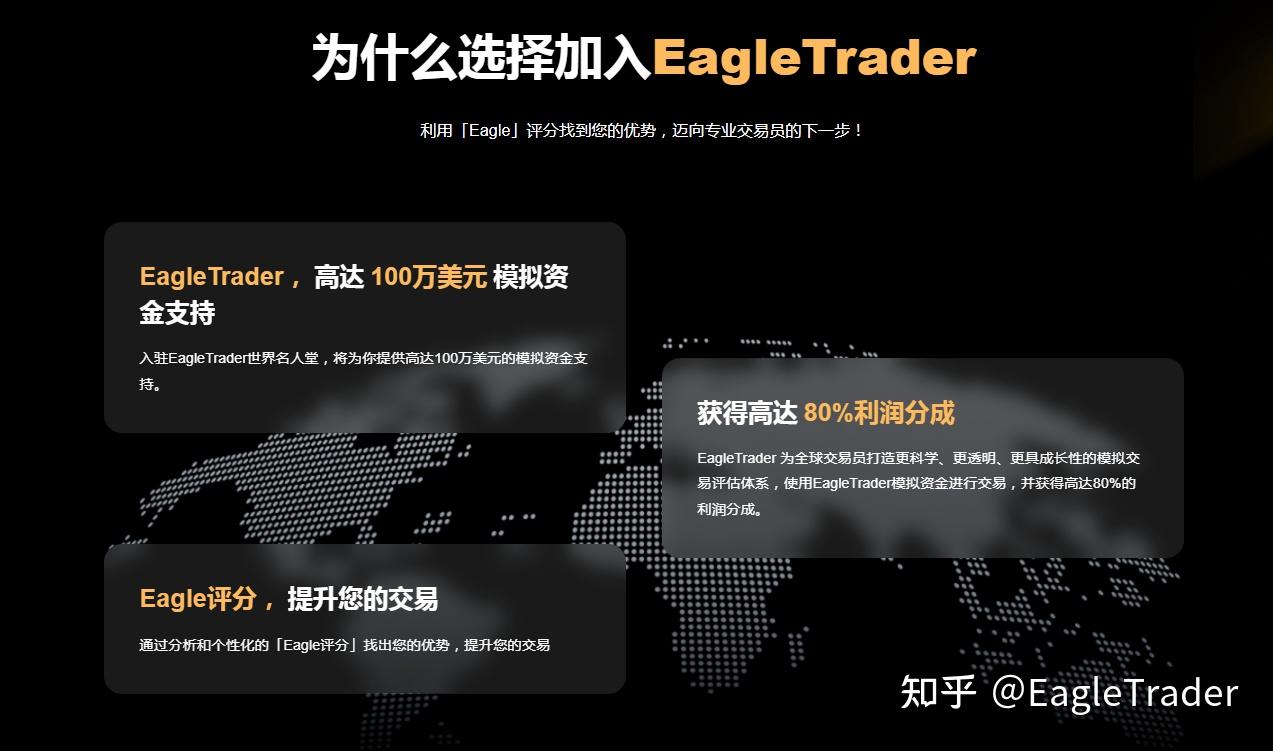
Based on your trading data, it will analyze from multiple dimensions such as trading habits, weak links, risk preferences, behavioral deviations, etc., and help you break down the vague “feeling wrong” into specific indicators that can be quantified and improved. Let growth change from “adjustment by feeling” to “improvement based on data.” Only by knowing why you are losing money can you not continue to lose money in the same way.
In the end, what traders really need is never just a profit opportunity. What is much more important than a single profit is establishing a set of trading capabilities that can operate stably in the long term. And the growth path of outstanding traders in the future is unlikely to be to repeatedly invest personal funds in the market.
A more reasonable path is: in a professional training environment with advancement and feedback, use actual combat to verify abilities, use data to discover problems, and optimize your own trading system in a positive cycle of continuous advancement.
ET Pro
What I want to do is this–to prevent those with real trading potential from being weighed down by the cost of trial and error in the early stages of growth, and to give their abilities the opportunity to move up a clear ladder to match larger transaction sizes and obtain more matching returns.
The threshold should never be funds, but ability. More knowledge about proprietary trading is still being shared. If you are interested, please follow us!