
Why is it easy to reverse after a short opening? Analyzing Larry Williams’ OOPS Turnaround Strategy
- 2026年8月13日
- Posted by: Eagletrader
- Category: News
In the EagleTrader Trading Insights series, we continue to share classic strategies in different trading systems to help traders understand the logic of market operation and explore the trading thinking behind the strategies.
Among the many trading masters, Larry Williams has always been the one that has attracted much attention.
He has created extremely influential trading records and left behind many classic trading methods. Among them, there is a set of trading models that he prefers, with a very special name – OOPS reversal strategy.
The word “OOPS” seems simple, but it reveals the core logic of this strategy: when market sentiment overreacts, the wrong party will often become the driving force for price reversal.

OOPS strategy: looking for opportunities from market “mistakes”
OOPS is not a complex combination of technical indicators, but a set of trading methods based on price gaps and changes in market psychology.
During the market opening stage, prices may open significantly higher or lower due to overnight news, changes in market sentiment and other factors.
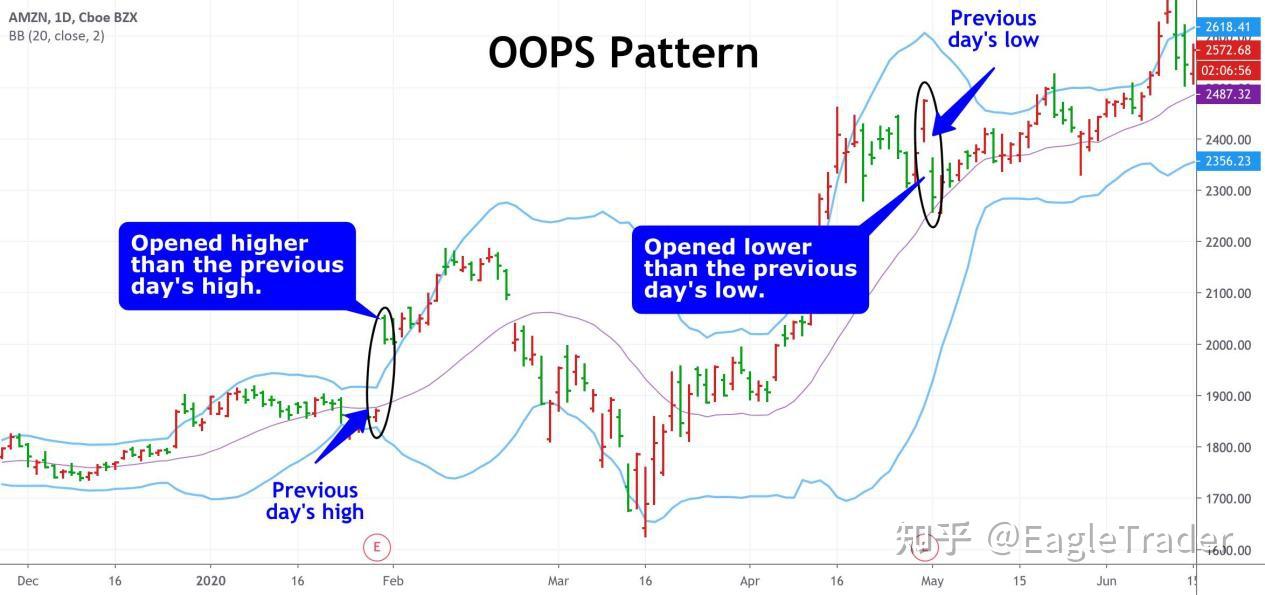
Faced with this kind of gap, some traders will choose to follow the direction immediately:
Continue to chase the rise after opening high; continue to chase short after opening low. But the market does not always continue in the direction it opened. When sentiment fades in early trading and prices return to key positions, traders who originally followed the market may face losses, and their stop-loss actions may further push prices in the opposite direction.
The OOPS strategy takes advantage of this change in market psychology to look for potential reversal opportunities.
Two basic trading patterns of the OOPS strategy
1. Be bullish on the OOPS pattern: take advantage of reversal opportunities after opening low
When the market is affected by negative emotions and opens significantly lower, you can pay attention to potential reversal opportunities.
Conditions for formation:
The opening price of the day is lower than yesterday’s lowest price, forming a downward gap.
Entry method:
Set a breakout buy order (Buy Stop) near yesterday’s lowest price.
If the price then breaks above yesterday’s lowest price upward, the trading signal is triggered. At this point, traders who were chasing shorts in the early trading may begin to come under pressure, while price rebound momentum gradually builds.
<img alt="" src="https://www.hudianbaoseo.cn/uploads/allimg/20260813/1786584273680016.jpg" width="654" height = 416
Conditions for formation:
The opening price of the day is higher than yesterday’s highest price, forming an upward jump gap.
Entry method:
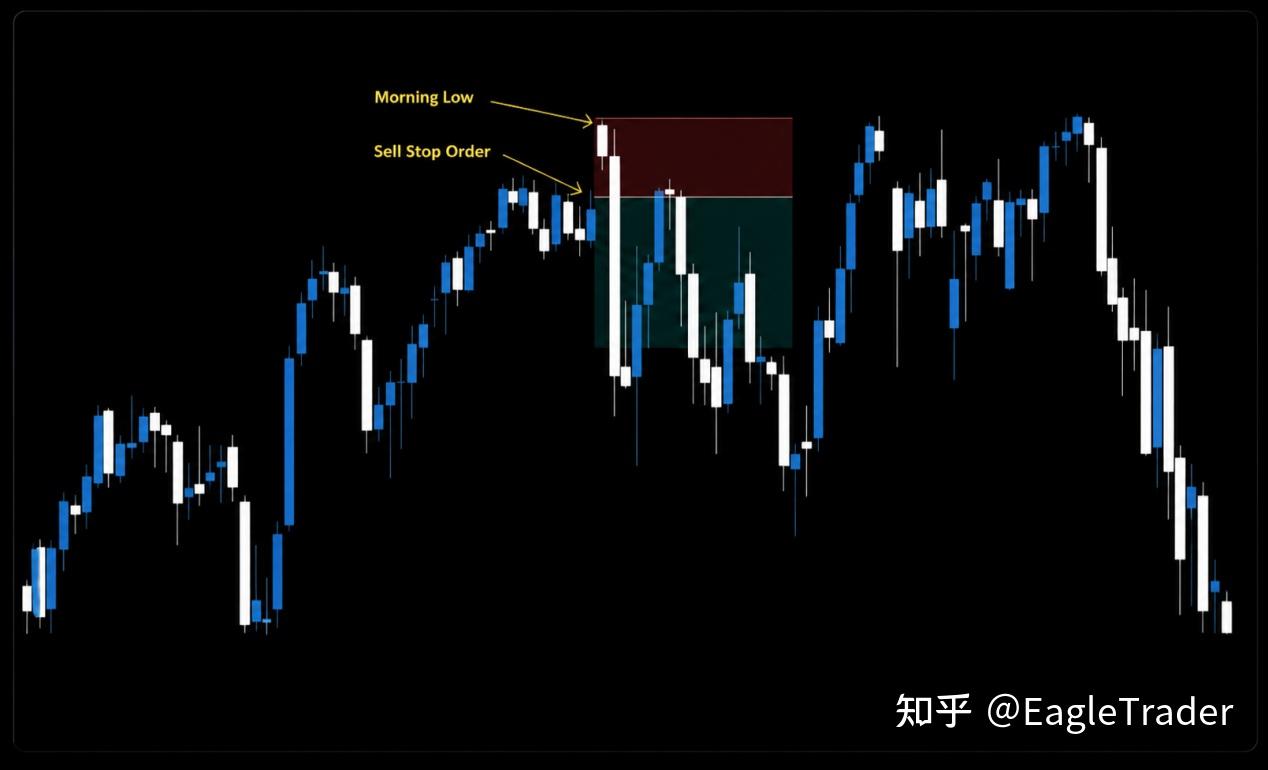
According to yesterday’s highest priceA breakout sell order (Sell Stop) was recently set.
If the price falls below yesterday’s highest price, the trading signal is triggered. As the chasing sentiment weakens, the market may enter an adjustment phase.
Risk management: a key link in strategy execution
No trading strategy can be foolproof, not even Larry Williams’ original tactics. Therefore, it is crucial to protect your principal well.
The common stop-loss methods include:
For long OOPS patterns: the stop loss is set below the lowest point of early trading of the day; for short OOPS patterns: the stop loss is set above the highest point of early trading of the day. If the market continues to move in the original direction, traders can exit according to preset rules and control risks within acceptable limits.
The trading inspiration behind the OOPS strategy
The OOPS strategy has attracted long-term attention, not because it can predict the market, but because it embodies several important trading concepts:
First, pay attention to changes in market sentiment.
Price fluctuations come not only from data and news, but also from trader sentiment. When markets overreact, new trading opportunities often arise.
Second, establish clear enforcement rules.
Entry, stop loss and trading conditions are clearly defined, reducing subjective judgment during the trading process.
Third, risk management always takes priority.
Excellent strategies not only focus on profit opportunities, but also on how to control possible losses.
Larry Williams’ OOPS reversal strategy tells traders: Market opportunities do not only exist after the trend is formed, but are sometimes hidden after the excessive release of emotions.
For EagleTrader
For traders, studying such classic trading strategies can not only help understand the market psychology behind price fluctuations, but also provide more ideas in the process of strategy development, market judgment and risk control.