
Will you have to try again if you fail the assessment? ET Pro Eagle Egg’s 3-time challenge mechanism turns failure into an opportunity for growth.
- 2026年8月13日
- Posted by: Eagletrader
- Category: News
For proprietary trading, the significance of assessment is not to judge how much profit the trader can make, but to observe whether he has the ability to execute stably, repair risks and continue to grow in the face of market uncertainty.
Therefore, EagleTrader
In the entry-level stage of the seventh-level promotion system – Eagle Egg, Pro is set with 1 initial challenge opportunity + up to 2 repair and retest opportunities, for a total of 3 challenge opportunities, and is equipped with an isolation balance repair mechanism.

When a trader triggers the maximum 7% loss limit, the entire assessment process will not end directly. Instead, on the basis of retaining the examination account data, the trader will regain the challenge qualification through fund repair.
This mechanism is not to lower the assessment standards, but to more comprehensively assess the traders’ comprehensive capabilities through the process of “challenge-repair-reverification”.
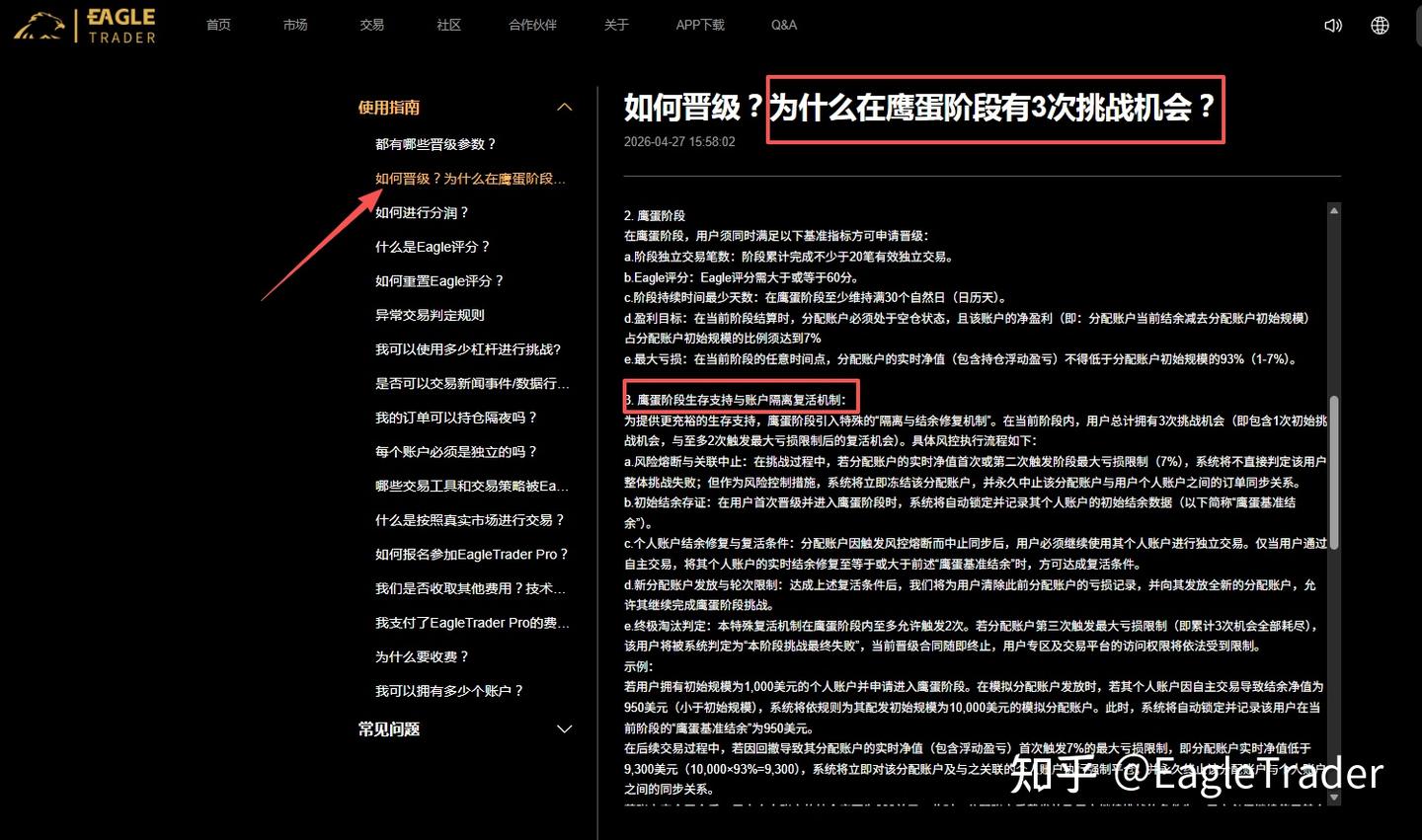
Explanation of the three challenge mechanisms of Eagle Egg
1. Reduce the impact of accidental market conditions and distinguish market fluctuations from real capabilities
There is always uncertainty in the trading market. Extreme market conditions, sudden fluctuations, liquidity changes, or even an unexpected transaction execution may lead to periodic withdrawals in the account. Even traders with mature trading systems cannot completely avoid short-term mistakes.
In the traditional self-operated assessment model, once the loss limit is triggered, the account is usually closed directly and the assessment needs to be restarted.
The three-time challenge mechanism of Eagle Egg distinguishes accidental market factors from traders’ true abilities by adding a repair verification link.
A trading error will not directly deny the trader’s long-term accumulated experience and ability, but give him the opportunity to analyze the problem, adjust the strategy and re-verify.
2. The account data is continuously retained and the transaction growth process is fully recorded
After the maximum loss limit is triggered, the assigned simulation account will enter the isolation state, but the exam account itself will not be destroyed. Transaction history, order records, risk performance and Eagle score related data will be continuously retained.

This means that traders do not need to re-create accounts or go through the pre-trade accumulation process again. Compared with simply “restarting after failure”, the Eagle Egg mechanism pays more attention to the complete growth trajectory of traders:
Which trading behaviors lead to risk exposure; how to adjust the strategy during the retracement process; whether the transaction execution is more stable after repair. Through continuous data accumulation, traders can have a clearer understanding of their own trading characteristics and optimize the trading system accordingly.
3. The repair process simulates retracement management in real trading
In the process of real fund management, retracement is not inevitable. Professional traders and ordinary tradersThe important difference between traders is not that the account will always remain profitable, but whether the risk can be effectively controlled and the trading status restored after a loss occurs.
The Eagle Egg repair mechanism requires traders to restore their account funds to the baseline balance when entering the Eagle Egg stage. Only after the repair is completed can a new challenge be started. This process itself is a capacity training:
Review the reasons for losses and find strategic loopholes; adjust position management to reduce risk exposure; optimize trading discipline and restore execution status; re-establish a stable trading rhythm.

Therefore, the repair phase not only examines profitability, but also the trader’s risk management ability when facing a stressful environment.
4. The three challenges correspond to different stages of ability verification
The three challenge opportunities of Eagle Egg are not simply to increase assessment opportunities, but to correspond to different ability verifications in the growth process of traders.
The first challenge: verify the basic capabilities of the trading system.
Traders need to prove that their strategies have the profitability and risk control capabilities to meet assessment requirements.
The second challenge: verify risk repair capabilities.
After experiencing an account drawdown, traders need to regain their status by adjusting strategies and optimizing risk management.
The third challenge: verify transaction stability.
After the first two rounds of feedback and optimization, traders need to further prove that their trading system has the ability to continue to execute.
Through multi-stage verification, EagleTrader Pro hopes that traders can learn to grow and learn lessons when trading is out of control, and achieve the effect of actual growth.
5. Reduce the psychological pressure of assessment and help traders maintain trading discipline
Entering the proprietary trading assessment stage for the first time, some traders are susceptible to the pressure of results. In order to achieve the goal quickly, there may be:
Excessive increase in positions; frequent trading; deviation from the original trading system. This behavior often amplifies risks and affects the performance of true trading capabilities. The three-time challenge mechanism of Eagle Egg provides traders with a reasonable space for trial and error.
Even if a mistake occurs in a challenge, it will not immediately enter a restart state, which can reduce the psychological pressure of “determining victory or defeat at once” and allow traders to focus more on executing the trading plan.
6. Tolerate mistakes but not let go, and adhere to strict risk standards
Three challenge opportunities does not mean lowering the assessment requirements. Each challenge is still strictly enforced with a maximum loss limit of 7%. Traders can only enter after completing fund repairs and meeting the Eagle Egg promotion requirements.Next round of challenges.
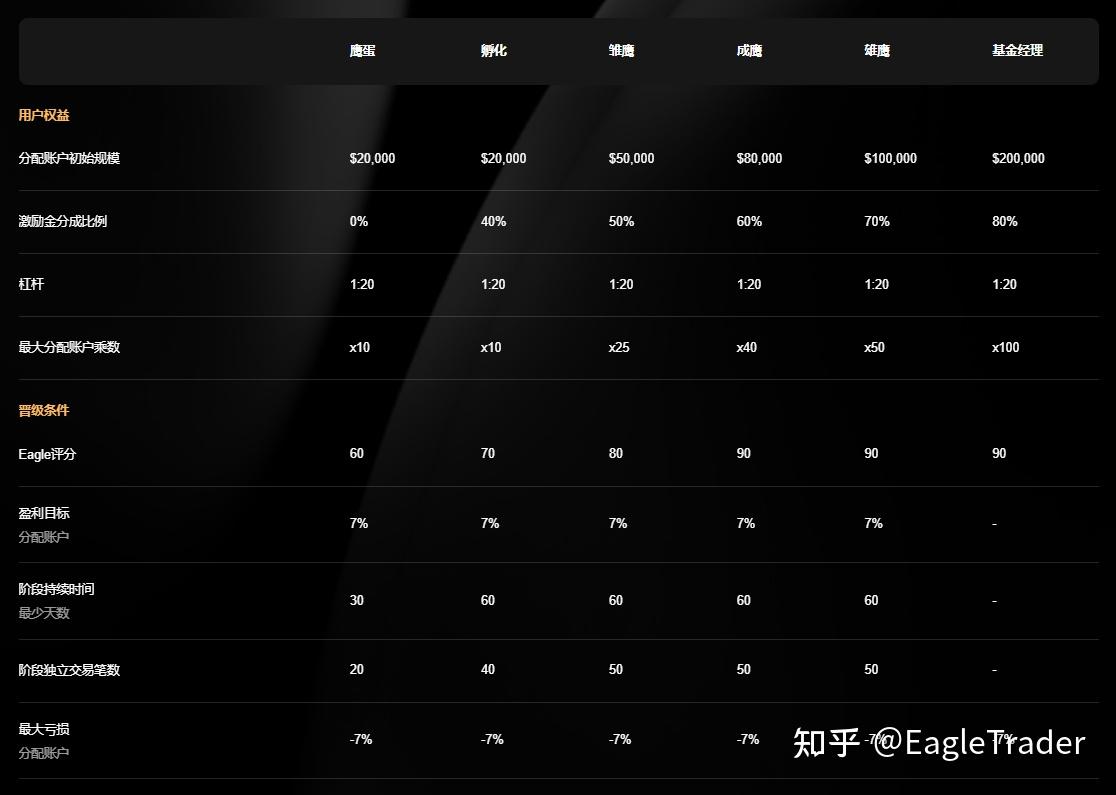
The mechanism reduces the impact of accidental market fluctuations on the evaluation results, not the trading ability threshold. What traders are really assessed on is their trading skills, risk control capabilities and trading consistency.
This is also the reason why the eagle egg stage establishes the ability foundation for subsequent hatching, eaglet, and other higher stages.
7. Reduce duplicate costs and speed up the overall promotion process
If there is no repair mechanism, once a trader fails, he needs to re-assess, re-establish transaction records, and complete the qualification challenge process again.
The Eagle Egg stage allows traders to continuously optimize based on existing transaction data by completing challenges, repairs and re-verifications within the same account.
For traders who already have a mature trading system, as long as they pay attention to their own risk control issues after the repair is completed, they can enter the next stage of challenges more quickly when they are familiar with the assessment mechanism, reducing time costs and improving growth efficiency.
The core value of the Eagle Egg’s three challenge mechanisms is not to give traders more opportunities to “start over”, but to provide a growth process that completely experiences market fluctuations, risk repair and ability verification.
It makes the assessment no longer just a judgment of results, but an important stage for traders to understand their own problems, optimize the trading system, and improve risk management capabilities.
Tolerate faults, but not let go; give room for growth while insisting on ability screening.
EagleTrader Pro hopes to help potential traders gradually establish stable trading capabilities and move towards a higher stage of career development path through a promotion system that is closer to the real trading environment.